
“I Will Bring You to My Son"- My Testimony


Mary brought me back to Jesus. This is my testimony.
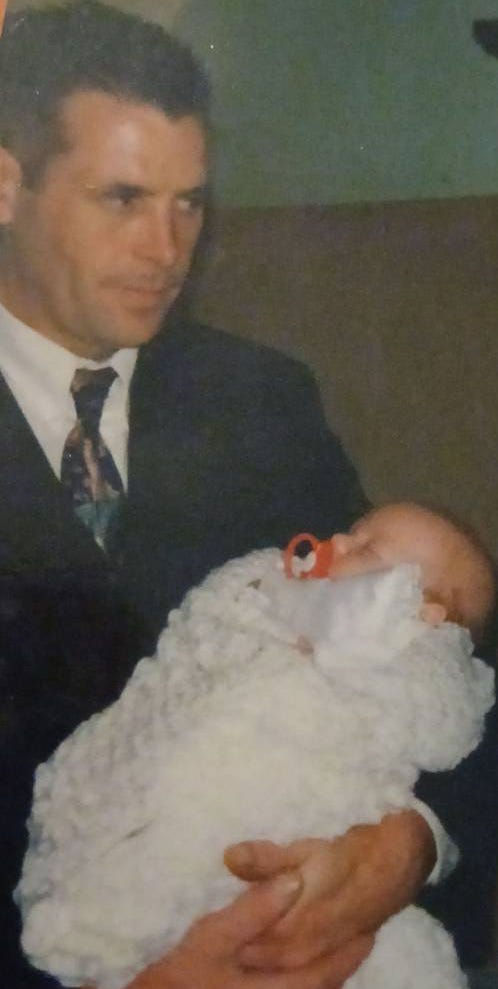
On the 27th Anniversary of my infant baptism, on the 29th November 2025, I confessed the sins of my entire life to a Catholic priest at the Shrine of Our Lady of Walsingham, and it changed my relationship with God forever. This decision, however, was not my own. I was led there by the Blessed Virgin Mary, Mother of God.
And in that sacred place, I found the mercy which I had spent decades running from.
My Walk in Darkness
When I was a baby, my parents were wise enough to baptise me, but were not practicing Catholics themselves. Consequently, I lived without direction for many years. My lifestyle was hedonistic, and “I was in love with my own ruin, in love with decay.” (Confessions of St Augustine, Book II). Unaware of the destructive path I was on, I became totally lost.
During this dark period of my life, there was no sense of meaning. Vanity became my god. I drank, smoked, partied excessively, and indulged in almost every sin under the sun. I was a wreck. As the glorious Apostle laments in Romans 7:24: “Wretched man that I am! Who will deliver me from this body of death?. Deep within my soul, I knew that something was wrong; something was missing. After my grandma passed away in my teenage years, I was consumed by misery; it was here that my self-indulgent recklessness reached its peak.
Vanity promises you happiness and leaves you hollow. I was burnt out. My reward for chasing women, taking drugs, and drinking myself to oblivion was a bleak coldness. I quickly slipped into the depths of nihilism.

The First Conversion
In my despair, I experienced an existential crisis at the age of 18. If I had to pinpoint my “wake-up” moment, this was certainly the beginning of it.
What was I living for? What is the purpose of life?
Relentlessly, I searched, but found answers in all the wrong places. I dabbled with psychedelics. I read countless self-help books to improve my life, yet they only caused me to withdraw even further into myself. Buddhism, Zen Buddhism, New Age practices, Stoicism, Greek philosophy. Like the moth, which is drawn to every flicker of light without prudence, I leaped from one school of thought into the next, yet I never felt satisfied. Eventually, like many young men who lacked guidance in life, I inevitably stumbled across Jordan Peterson.

Out of nowhere came this psychology professor with a funny voice who was drawing thousands of people into arenas to talk to them about God and some dusty old book called The Bible.
I was fascinated. What was behind this phenomenon?
I thought Christianity was lame; no one takes that seriously, right?
Curious as I was, I watched countless hours of his biblical lectures, which led me down a rabbit hole of watching theologians such as William Lane Craig debate atheists like Christopher Hitchens and Richard Dawkins. At this time, I was ‘wrestling with God’, reluctantly drawing closer to Him while questioning his existence.

A question dawned on me: Why do so many westerners like myself look everywhere for spirituality, except within our own tradition, inherited from our own ancestors? Little by little, the Holy Spirit was illuminating my conscience and removing each of the misconceptions I had about Him. I purchased my first ever Bible, and by providence, I flicked to the book of Proverbs.
Proverbs 7:24–27 (emphasis mine)
“And now, my son, listen to me,
and attend to the words of my mouth.
Let not your heart turn aside to her ways [seductress];
do not stray into her paths.
For many a victim has she laid low;
yea, all her slain are a mighty host.
Her house is the way to Sheol,
going down to the chambers of death.”
I was convicted. No other spiritual path I had previously explored had spoken to me in this way. “My son.” Those words struck me with unexpected force. They carried the voice of the fatherly guidance I had lacked, calling me, not with condemnation, but with clarity and love. This passage told me what I had long refused to admit: that the pleasures I believed had fulfilled me were, in truth, leading me toward my own destruction. It was as if a mirror had been held up before me, peering directly into my soul, exposing not only my sins, but the emptiness beneath them.
I finally conceded. All these years, God was silently beckoning to me, protecting me from complete destruction, and He used the aforementioned instruments to lead me back home.
The zeal of my initial conversion overwhelmed me, but it wasn’t genuine. I was only a Christian in name, treating faith like another self-help tool. In my mind, Jesus was simply a wise figure, a “good guy” whose example I could use to fix my life. As C.S. Lewis famously wrote in Mere Christianity:
“A man who was merely a man and said the sort of things Jesus said would not be a great moral teacher. He would either be a lunatic—on a level with the man who says he is a poached egg—or else he would be the Devil of Hell. You must make your choice. Either this man was, and is, the Son of God, or else a madman or something worse.”
It wasn’t until I met my wife, Melissa, who had converted around the same time, that I encountered authentic faith. Her devotion inspired me to take my own seriously. I was also drawn back by the example of my grandfather, the last truly practicing Catholic in my immediate family. Through them, I came home to the Church.

I was confirmed in the faith in 2022. However, my priest, who was carrying a heavy pastoral workload, was unable, through no fault of his own, to provide the full RCIA formation (the Rite of Christian Initiation of Adults). As a result, I never made a general confession beforehand. It is customary for adult converts to make such a confession prior to confirmation, confessing the serious sins of their past so as to approach the sacrament with a soul made clean, in a manner analogous to baptism.
This, in turn, led me to develop scrupulosity. As I became more learned in the faith, I became consumed by the fear that none of the sacraments I had received in the years that had passed were even valid. As Saint Paul warned the Church in Corinth regarding taking communion unworthily:
1 Corinthians 11:27–29:
Whoever, therefore, eats the bread or drinks the cup of the Lord in an unworthy manner will be guilty of profaning the body and blood of the Lord. Let a person examine himself, then, and so eat of the bread and drink of the cup. For anyone who eats and drinks without discerning the body eats and drinks judgment on himself.
What had once felt like a sweet fragrance and the fresh breath of new life in my faith had turned into a crushing burden. By neglecting to make a general confession early in my faith, I was actively wounding the Lord and trampling on His mercy. Pride had taken root in my heart. I judged others harshly while ignoring the plank lodged firmly in my own eye. Every day, I felt the weight of my sins pressing down on me, a constant reminder that I had been running from the very grace meant to set me free.

The Second (True) Conversion
So far, I have set the stage for what would soon become the most profound moment of my entire life. Desperately searching for a solution to my crisis of faith, I began researching others who had undergone similar conversion experiences. My situation felt uniquely isolating; I had no one to turn to. When I asked friends in the faith, most told me that I didn’t need to make a general confession, though it might be good for my soul. I remained uncertain. Saints, such as Ignatius of Loyola and Francis de Sales, strongly recommend a general confession, yet I carried sins so dark and so embarrassing that I could scarcely imagine speaking them aloud.
In this desperation, one night I cried out to Our Lady, the Blessed Virgin Mary, Mother of God, and she answered. I heard a voice say, “Trust in me, and I will bring you to my Son.” Shortly thereafter, a new friend of ours, Peter, invited us on pilgrimage to Our Lady of Walsingham. By divine providence, the date he had booked fell on the anniversary of my infant baptism. Oh, what grace! What wonder! God had answered my prayer through the intercession of Our Lady of Walsingham.
She had promised to lead me to her Son, and here was the perfect opportunity to make the general confession I had wrestled with for months. What better time? I took out a pen and notepad, invoked the Holy Spirit to reveal my sins, and wrote a lengthy confession spanning my entire life, childhood, adolescence, early adulthood, and both before and after my conversion. As I reread it, my tears wet the pages, laid bare by the sorrow of seeing my life’s wretchedness in the light of God’s mercy.
Short tangent for non-Catholics: The Sacrament of Reconciliation
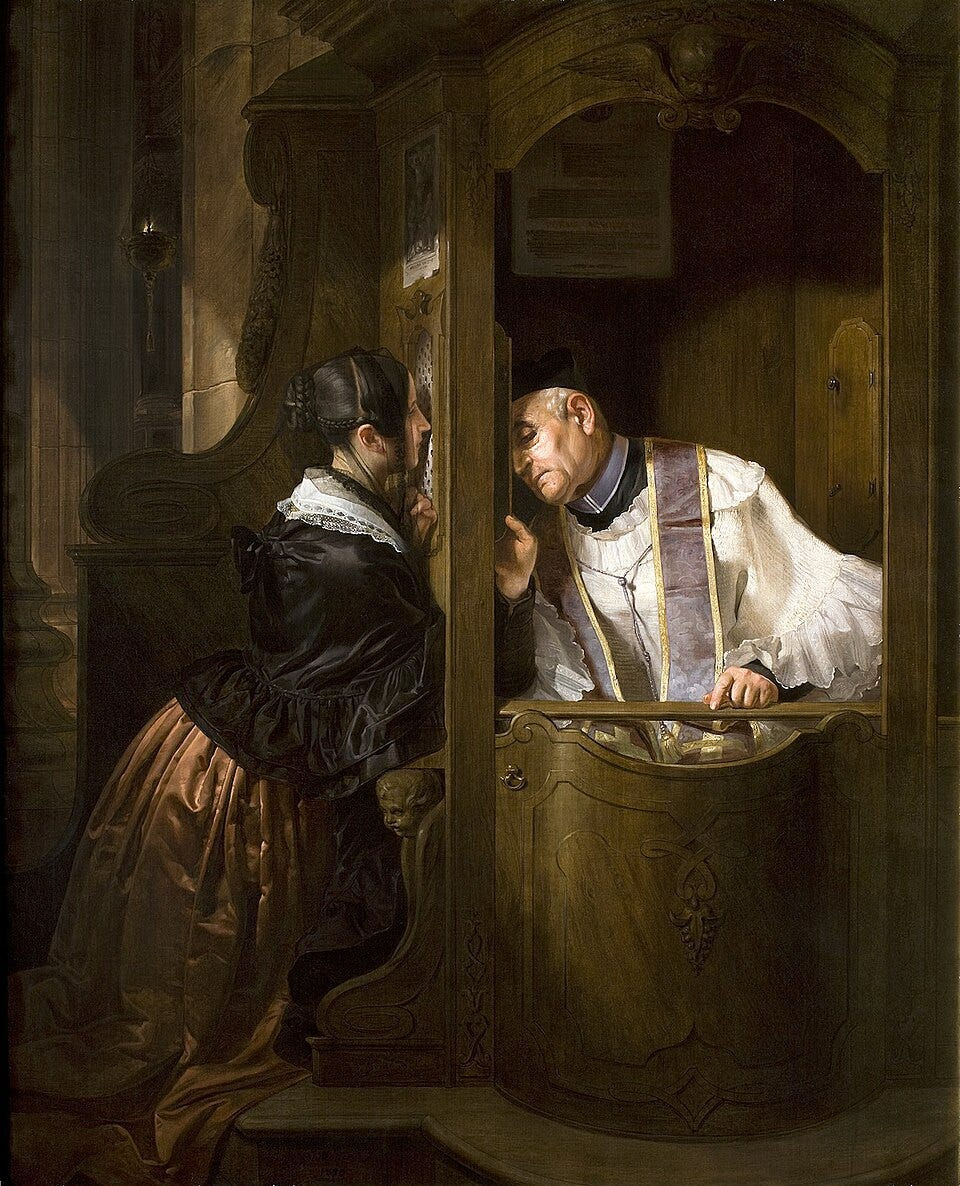
A skeptic might ask “so you Catholics really believe that you can commit the most grievous sins imaginable, then just go and privately tell them to a priest and he just says a few magic words, waves his finger and all is forgiven?”

This is the "Good News": Jesus died for our sins, paying the price for us. But it doesn’t stop there. He gave His disciples the authority to forgive sins, saying, “Whose sins you forgive are forgiven them, and whose sins you retain are retained” (John 20:23). This authority has been passed down through the generations by the laying on of hands, ordaining priests and deacons, as seen in Acts 6:6: “They presented these men to the apostles, who prayed and laid their hands on them,” and 1 Timothy 4:14: “Do not neglect the gift you have, which was given you by prophecy when the council of elders laid their hands on you.”
This is not merely a human invention. History attests to the practice of sacramental confession, even outside the Bible; for example, early Church Fathers, such as Tertullian in On Repentance (c. 200 AD), describe confessing sins to a presbyter and receiving absolution.
For this reason, the priest acts “in persona Christi,” meaning Christ is truly present in the confessional. We confess our sins directly to Him, and the mercy that flows from His wounds heals us, restoring our souls to grace. This sacrament is only effective when we have true sorrow for the sins which we confess, with a firm resolve to repent and, with the help of God’s grace, turn away from them and sin no more.

Our lady of Walsingham Shrine
We arrived at Walsingham, often called “England’s Nazareth.” In 1061, Our Lady appeared to Richeldis de Faverches, asking her to build a replica of the Holy House of Nazareth. From that moment, Walsingham became a place of prayer and pilgrimage, drawing countless souls seeking Mary’s guidance. Though it was destroyed during the Reformation, the shrine was rebuilt in the 20th century, once again welcoming pilgrims to encounter her Son through her maternal care.

Despite the excitement each of us felt on our way to the Shrine, a sense of fear and dread overshadowed me. In less than 24 hours, I was about to confess the worst things I had ever done across my entire life to a priest. What if he shunned me? What if I get scared and don’t follow through? All these thoughts raced through my mind as the clock ticked down.
We arrived on the first night, and after prayers in the Holy House, we gathered in the common room to socialise. The thought of confession loomed constantly in the back of my mind, yet I masked it with smiles and laughter.
The next morning, judgment day had come. We walked the barefoot mile to the Catholic shrine for Mass. There, in the ancient Slipper Chapel, we attended a beautiful, reverent Mass. Afterward came the moment I had been dreading: confession and adoration in the Reconciliation Chapel. My heart was pounding in my chest.
I knelt before the Blessed Sacrament, where Christ is truly present, and prayed for courage. Then, almost as if I were no longer in control, I stood and walked straight to the confessional. I was the first to enter. Kneeling down, trembling, I pulled out my concealed notebook.
“Bless me, Father, for I have sinned. It has been two weeks since my last confession, and I would like to make a general confession, if that is alright?”
“Yes,” a gentle voice replied behind the veiled screen.
Without hesitation, I poured out the darkest secrets of my entire life, my childhood, teenage years, early adulthood, and every failing since. My voice shook, and I stuttered, but I concealed nothing. When I finished, there was a pause… a silence more profound than anything I had ever experienced. The suspense was unbearable.
“God is merciful,” whispered the priest.
A rush of euphoria swept through me. How could this be? I don’t deserve this! The priest offered guidance, and I made my act of contrition. Then, in the words of the Church’s ministry:
“…Through the ministry of the Church, I absolve you from your sins in the name of the Father, and of the Son, and of the Holy Spirit.”
Upon hearing these words, I felt a peace that transcended all understanding. As St. Paul wrote, “Therefore, there is now no condemnation for those who are in Christ Jesus” (Romans 8:1). In that moment, I truly understood the depth of God’s mercy.
I was no longer shackled to my past life, no longer haunted by it. Instantly, I was set free from my self-inflicted bondage.
This was my second baptism.
Our Lady promised me she would lead me to her son, and she answered that promise.
I have not told this account in order to boast, for none of this came from my own doing. All glory, honour, and praise belong to Jesus Christ, Our Lord, and the unfailing intercession of our Mother, the Blessed Virgin Mary.

Thank you for taking the time to read my testimony. If you are afraid of confession, I urge you: run to the confessional. Remember the words of St. Francis de Sales: “Sin is like a scorpion that stings the soul; but when it is confessed, it is changed into a sweet perfume that rises to God.” - Introduction to the Devout Life. Your sins are surely not worse than mine were, and God is waiting there to embrace you with His mercy. Trust in Him, this encounter will change your life.
My friends Alex and Roy documented our experience at Walsingham, which you can watch here:


Comments